



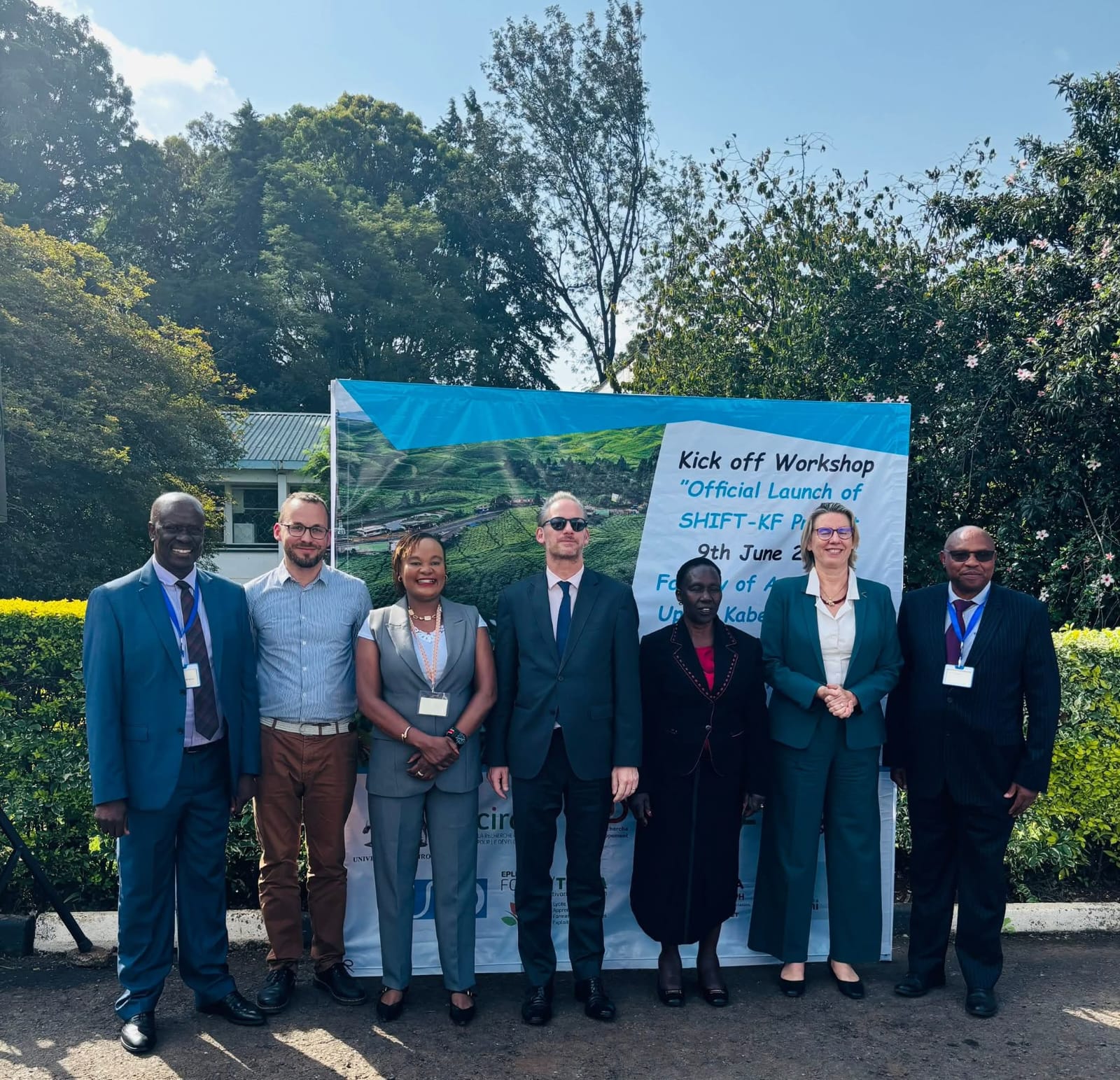
The Strengthening Higher Institutional Agriculture and Food Training – Kenya-France (SHIFT KF) Project was officially launched on Tuesday 9th June at University of Nairobi Upper Kabete Campus.The project, a collaborative academic and research initiative co-coordinated by the University of Nairobi (UoN) and AgroParisTech, brings together Kenyan and French institutions in a shared commitment to enhancing higher education in agriculture and food systems. The launch ceremony was officiated by the French Ambassador to Kenya, H.E. Mr. Arnaud Suquet, who underscored the importance of international partnerships in addressing global food security and agricultural sustainability challenges.
The event was hosted by the University of Nairobi's Faculty of Agriculture and Faculty of Business and Management Sciences and attracted representatives from government, academia, development agencies, industry, and the diplomatic community.Funded by the French Development Agency (AFD) and managed by the French National Research Agency (ANR), the SHIFT KF Project seeks to strengthen the capacity of African higher education institutions to produce graduates equipped with the skills and knowledge required to transform agricultural and food systems.
Speaking during the launch, university leaders highlighted the growing need for innovative and responsive agricultural training programmes that can address emerging challenges such as climate change, food insecurity, technological advancement, and changing market demands. They noted that institutions of higher learning have a critical role to play in preparing future leaders capable of driving sustainable agricultural development across the continent.
At the heart of the SHIFT-KF Project is a commitment to curriculum development, academic excellence, and international collaboration. The initiative will support the modernization of agricultural and food systems training programmes while promoting student and faculty mobility between Kenya and France. Through these exchanges, participants will gain exposure to diverse learning environments, advanced research methodologies, and innovative agricultural practices.
The project also places significant emphasis on building strong partnerships with French and local agricultural enterprises. By engaging industry stakeholders in curriculum design and implementation, the initiative seeks to ensure that academic programmes remain relevant to socioeconomic realities and the evolving needs of the agricultural sector.
Stakeholders attending the launch described the project as a bridge between academia and industry, creating opportunities for students to acquire practical skills and experience while enabling researchers and educators to collaborate on solutions to real-world challenges affecting food production and agricultural value chains.
French Ambassador H.E. Mr. Arnaud Suquet praised the longstanding relationship between Kenya and France and reaffirmed France's commitment to supporting education, research, and innovation as key drivers of sustainable development. He noted that strengthening agricultural education is essential to building resilient food systems capable of feeding growing populations while protecting natural resources.
For students and faculty members, the SHIFT KF Project represents new opportunities for learning, research, and international engagement. The initiative is expected to facilitate collaborative research projects, strengthen institutional networks, and promote knowledge exchange between Kenyan and French scholars.
As the ceremony concluded, participants expressed optimism about the project's potential impact on agricultural education and food systems transformation in Africa. By combining academic expertise, research excellence, and industry partnerships, the SHIFT KF Project is poised to contribute significantly to the development of a skilled workforce capable of addressing the complex agricultural challenges of the future.
The launch at the University of Nairobi signals not only the beginning of a new academic partnership but also a shared vision between Kenya and France for a more innovative, sustainable, and food-secure future.


